Shohei Ohtani
"The man from Oshu who made baseball rethink what a player can be"
When Ohtani signed the largest contract in professional sports history, he reportedly deferred the vast majority of the money — not for legal or tax reasons, but so the Dodgers could build a better roster around him.
In 2026, Ohtani is in the heart of his Dodgers years, still the only true two-way player in the modern game and the central figure in one of baseball's most closely watched rosters. How long he can sustain both roles — and what the attempt will have meant when it ends — is one of the sport's genuinely open questions.
The mainstream narrative treats Ohtani primarily as a statistical phenomenon. What gets overlooked is the cultural framework — Japanese concepts of preparation, craft, and collective responsibility — that shapes how he plays and carries himself, and that American observers see but often misread.
American teammates and coaches consistently describe Ohtani's clubhouse presence in terms that don't quite map to Japanese sports vocabulary: they call him a 'leader,' but what they seem to mean is that his consistency of preparation and demeanor — being exactly the same person whether it's a pitching day or a hitting day — creates a standard that others feel compelled to match. In the United States, this quiet, non-verbal influence is genuinely unusual and highly prized; American players often struggle to name it, because their model of leadership is built around speech. What they are reaching for, without knowing it, is a concept his home culture has had vocabulary for all along.
Ohtani is frequently seen picking up small pieces of litter from the field — a habit American fans have photographed and shared, usually filing it under 'charming quirk' or 'tidiness.' In Japanese cultural context, however, the practice is connected to a broader idea: that tending the space you occupy and collecting what others discard is a form of gathering good fortune. It is not quite superstition; it is closer to a philosophical stance about one's relationship to the world. When Ohtani picks up a candy wrapper from the outfield grass, he is not, by the logic of his own tradition, doing housekeeping. He is picking up luck.
Shohei Ohtani, born July 5, 1994, in the small Tōhoku city of Oshu, Japan, is a pitcher and designated hitter for the Los Angeles Dodgers — the only active player in MLB to perform both roles at an elite level. Standing 6'4" and building a career that has forced the sport to revisit its own assumptions, he brings to American baseball a set of habits, a quietness, and a seriousness about craft that has captured the imagination of fans and confounded easy categorization for nearly a decade.
| Year | Team | G | W–L | ERA | IP | SO | WHIP |
|---|---|---|---|---|---|---|---|
| 2026 | LAD | 14 | 8–2 | 1.79 | 85.2 | 95 | 0.95 |
| 2025 | LAD | 14 | 1–1 | 2.87 | 47.0 | 62 | 1.04 |
| 2023 | LAA | 23 | 10–5 | 3.14 | 132.0 | 167 | 1.06 |
| Career | — | 114 | 47–22 | 2.83 | 614.1 | 765 | 1.06 |
| Year | Team | G | AVG | HR | RBI | SB | OPS |
|---|---|---|---|---|---|---|---|
| 2026 | LAD | 134 | .277 | 30 | 80 | 11 | .902 |
| 2025 | LAD | 158 | .282 | 55 | 102 | 20 | 1.014 |
| 2024 | LAD | 159 | .310 | 54 | 130 | 59 | 1.036 |
| Career | — | 1167 | .281 | 310 | 749 | 176 | .950 |
Source: MLB Stats API · regular season
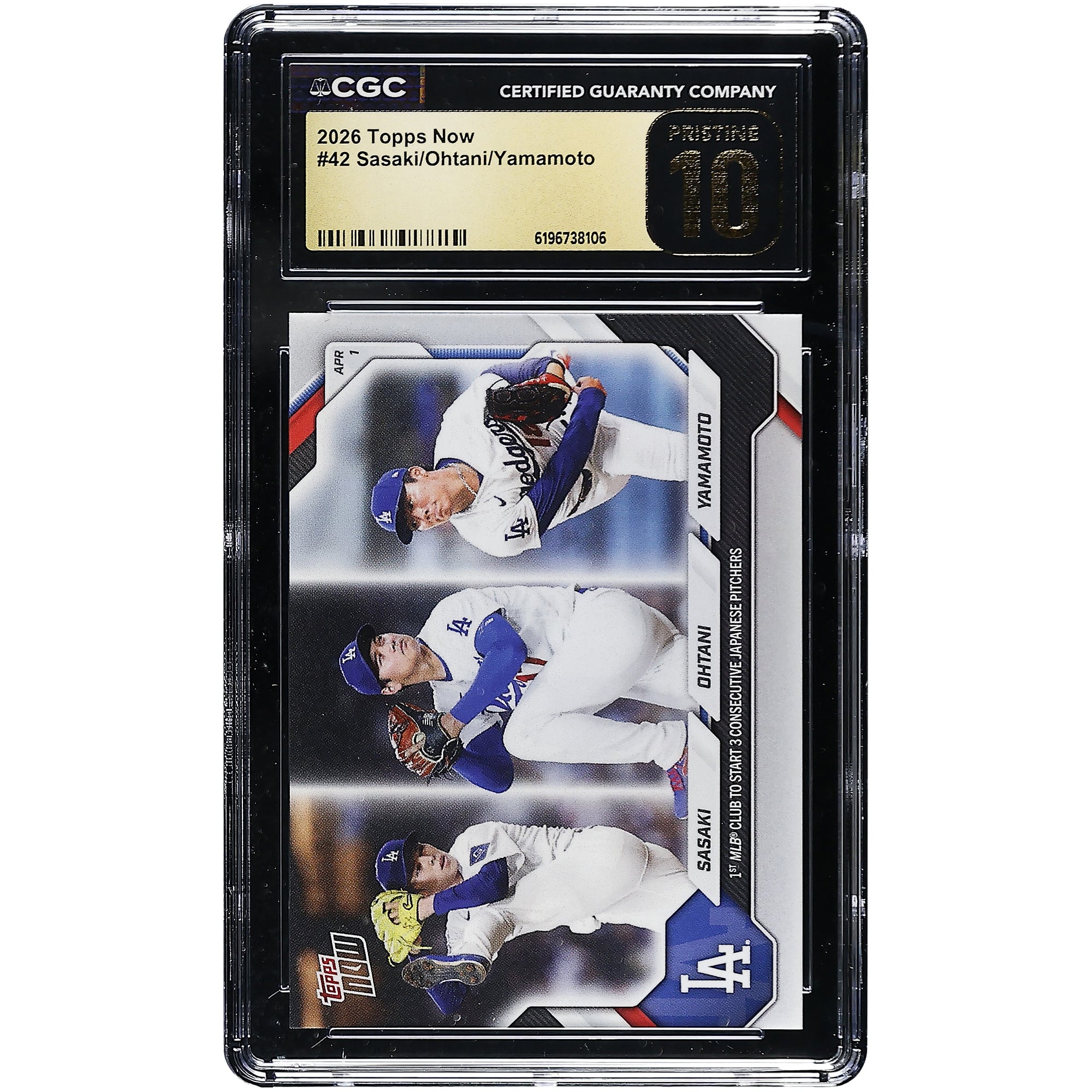 Topps NOW AD Yoshinobu Yamamoto, Shohei Ohtani & Roki Sasaki Los Angeles Dodgers 2026 Topps Now 1st MLB Club to Start 3 Consecutive Japanese Pitchers #42 CGC Authenticated PRISTINE 10 Card See it at the official MLB Shop →
 The Field as a Space to Tend
When Shohei Ohtani jogs across a baseball field, he does something that American fans have photographed, shared, and discussed without quite knowing what to make of it: he picks up pieces of litter and debris from the grass and the dirt. Not as a gesture. Habitually. Reportedly, the practice is rooted in a Japanese concept of gathering good fortune — the idea that attending to your surroundings, taking in what others overlook, invites luck back toward you. Teammates watching from the dugout have tended to read it as conscientiousness, or humility, or both. In the tradition from which Ohtani emerged, it is something more specific: a form of discipline directed not at the self but at the space the self inhabits. It is, in this sense, a compressed statement of philosophy — and a useful introduction to who he is.
Where He Comes From
Ohtani was born on July 5, 1994, in Oshu — a city of roughly 120,000 people in Iwate Prefecture, in Japan's Tōhoku region. To most American readers, this is simply a place name. To Japanese readers, Tōhoku carries a specific weight: it is the northeastern interior of Honshū, historically associated with agricultural tenacity and a certain remove from the cultural centers of Tokyo and Osaka, and since the catastrophic earthquake and tsunami of March 2011, a name that resonates with collective grief and the long work of rebuilding. An athlete from Tōhoku is, in Japanese cultural shorthand, not from nowhere — he is from a particular kind of somewhere, a place that values self-sufficiency and does not tend to seek the spotlight. This is not a minor biographical footnote. It is, for those who know how to read it, a lens through which much else about his public character becomes clearer.
Tōhoku (東北, literally 'northeast') is the northern region of Japan's main island, Honshū. It is known for harsh winters, agricultural and fishing traditions, and a cultural temperament that the Japanese themselves often describe as 'enduring' or 'stoic' (我慢強い, gaman-zuyoi). It is also the region most devastated by the earthquake and tsunami of March 11, 2011 — a national trauma that deepened Japan's collective sense of the region as a place that absorbs hardship without drama. For Japanese readers, an athlete from Tōhoku carries an implicit background note; for American readers, the equivalent might be an athlete from a rural Appalachian town — a place associated with a specific, unglamorous kind of resilience.
The Two-Way Question
Ohtani debuted in Major League Baseball on March 29, 2018, as both a pitcher and a position player — a dual role the sport had largely ceased to consider viable after decades of specialization had hardened the game's internal logic. The Babe Ruth comparison arrived almost immediately, and it is partly apt and partly limiting. Ruth played both ways in an era before the game had drawn hard lines between pitching and hitting; Ohtani does it after a century of specialization has made those lines seem like laws of physics. As widely documented, he was the first pick of the Hokkaido Nippon-Ham Fighters in the 2012 NPB draft, spent five seasons in Japan as both pitcher and outfielder, and won a Japan Series championship in 2016. By the time he arrived in MLB, he had already demonstrated that his approach was not a promotional novelty but a considered philosophy — one that the Fighters, and later the sport itself, were forced to accommodate.
The Quiet Figure in the Loudest League
American professional sports culture places enormous value on verbal leadership — the player who speaks in the locker room, who rallies teammates, who commands attention through words. Ohtani, who conducts his English-language press interactions through interpreters, has occupied an unusual position in this landscape. He is, by nearly all accounts, deeply respected by teammates and coaching staff, and yet his influence operates through example and consistency rather than speech. American sports vocabulary does not have a clean term for this kind of authority, and so observers have reached for approximations that circle the quality without fully naming it. In Japan, leadership through craft and sustained presence would require considerably less explanation. In December 2023, he signed a 10-year, $700 million contract with the Los Angeles Dodgers — the largest in professional sports history at the time of signing. He reportedly agreed to defer the vast majority of that sum, approximately $680 million, until after the contract period concluded, freeing the team to build its roster in the years he would be playing for them. This arrangement, remarkable in a league where maximizing immediate earnings is treated as both rational and expected, attracted wide comment. It was also, to anyone paying attention to the kind of person Ohtani appears to be, entirely consistent with the profile he had established.
What the Sidebar Cannot Hold
The statistics beside this piece describe Ohtani's career in the terms the sport has devised for measuring performance. They do not describe the particular quality of attention that Japanese sports culture encodes in its concepts of propriety and craft — the sense that one's vocation is an obligation to be met with full seriousness, not a talent to be expressed or a role to be filled. They do not describe Oshu, or what it means in Japan to come from the northeast and arrive at the center of a global sport. Ohtani is 31 years old in 2026. The central question surrounding his career — how long he can sustain elite performance across two demanding disciplines as his body accumulates the work — remains genuinely unanswered. What seems settled, at this point, is the kind of player and person he has been in the years we have watched him: someone who tends the field, defers the money, and declines to make more noise than the work itself requires.
Japanese players — including Ohtani during his NPB years — bow to umpires, opponents, and the field itself as a matter of routine. American fans often register this as politeness, and it is that, but the bow (お辞儀, o-jigi) carries specific social meaning in Japan depending on its angle, duration, and context. Bowing toward an umpire after a call is not an expression of agreement or submission; it is an acknowledgment of the game's structure and the official's role within it. Bowing toward the field before leaving it is an expression of gratitude toward the space itself. These are not ceremonial flourishes added on top of the game; they are habits embedded over years in a sports culture that treats comportment and performance as inseparable.
In American professional baseball, 'clubhouse leader' describes a player who creates team cohesion through personality — someone who speaks, mediates, motivates, and manages the social environment through visible action. The concept is fundamentally verbal. Japanese team sports culture also values collective cohesion, but the mode of contribution tends to be demonstrated rather than announced. The player who arrives earliest, whose preparation is most meticulous, and whose composure never wavers is exercising leadership in a form that Japanese sports culture recognizes and names clearly. When American teammates reach for language to describe Ohtani's presence — and they do — they are, often without knowing it, groping toward a concept that his home culture encoded long ago.
Official MLB Shop and Amazon links matched to Shohei Ohtani and the Los Angeles Dodgers.
Shohei Ohtani Gear — Official MLB ShopThis profile was written by AI (Claude Sonnet) using publicly available sources. Interpretations and cultural notes are AI-generated and may not reflect the views of the player, their team, or MLB. This page contains affiliate links.